
Buying property in Sharm El Sheikh: ownership, usufruct and resale
Journal · 2026-11-04
In Sharm El Sheikh, “buying a home” may mean acquiring different legal rights. The 2005 decree sets out a residential usufruct route of up to 99 years for non-Egyptians and contemplates disposal of rights acquired under that decree. Later rules create a special mapped regime for parts of South Sinai, with additional limits and approvals. This guide explains what the texts say—and why a property’s exact coordinates and registered title matter.
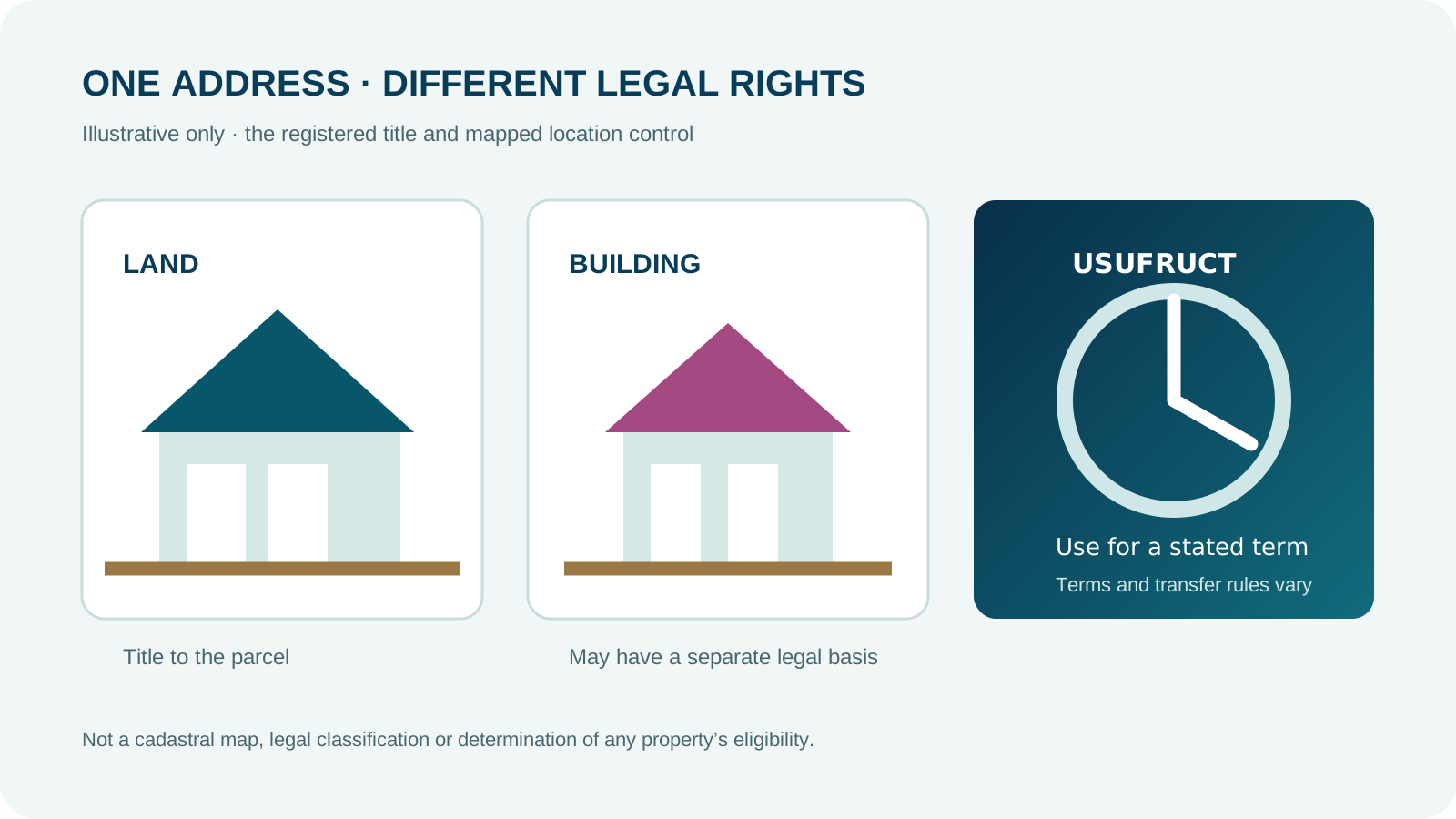
Original Visit Sharm illustration. It describes general legal concepts only; it does not identify a parcel or determine which rule applies to a property.
First identify the right, not the listing label
A listing may call a transaction “ownership”, “freehold”, “usufruct”, “lease” or “use right”. These words are not interchangeable. Ask for the registered instrument and identify separately whether the proposed transfer concerns land, a building, a residential unit, a time-limited usufruct or shares in a company. A private promise or translated marketing description does not establish title, duration, transferability or registration.
What Decree 548/2005 says about Sharm
The Egyptian investment authority reproduces Prime Ministerial Decree 548/2005 as amended by Decree 2152/2014. Article II says that, by decision of the competent authority and following approval by relevant authorities, non-Egyptians may be granted residential usufruct over units in the City of Sharm El-Sheikh for no more than 99 years. Article III says that non-Egyptians who own or hold usufruct under that decree may dispose of the units from the date they acquire the relevant right; registration or notarisation follows completion of the required documents. This is a route with stated conditions—not proof that every advertised unit qualifies, or that any private contract is enough.
The general Sinai framework and its geographic limits
Decree-Law 14/2012 and its Executive Regulations (Prime Ministerial Decree 959/2012) set out a general framework for integrated development in the Sinai Peninsula. The regulations require geographic areas and responsible authorities to be identified through the prescribed decisions and maps, and state nationality-related limits on land and built-property ownership. These rules cannot be applied to a specific address merely because it is described as “in Sinai”: first establish the parcel’s location and the legal instrument governing it. Decree 128/2022 later establishes a special framework for mapped areas including Sharm El-Sheikh, Dahab and the Gulf of Aqaba Tourist Sector.
What the 2022 special decree changes—and what it does not answer by itself
Presidential Decree 128/2022 sets special rules for Sharm El-Sheikh, Dahab and the Gulf of Aqaba Tourist Sector according to attached maps and coordinate tables. It reserves ownership of land and built real estate in the covered areas to Egyptian individuals and wholly Egyptian-owned legal entities, while preserving acquired rights. For land and property in the State’s private domain, it provides for usufruct for a total term of up to 75 years; during the term the usufruct holder may own structures built on the land, and the decree allows those structures to be sold separately from the land. It also requires approvals from the named authorities for property ownership, allocation, residence-use, usufruct and other real-estate or in-rem dispositions; contracts that breach its rules are stated to be absolutely void. These provisions are tied to the decree’s scope and do not, without the title and coordinates, resolve how an older individual right interacts with the later regime.
Can an usufruct be transferred, or a home sold privately?
There is no safe blanket answer. Article III of Decree 548/2005 contemplates disposal by a holder who acquired ownership or usufruct under that decree. The general Sinai rules and Decree 128/2022 impose their own procedures, scope limits and approvals; the 2022 text also addresses the sale of structures separately from land in a defined State-private-domain usufruct arrangement. A transfer between private parties may therefore be possible only if the specific right, contract, location, applicable decisions and required consents allow it. “Usufruct” alone does not tell a buyer whether assignment, resale, inheritance or registration is permitted.
Documents to have checked before paying
Ask an independent Egyptian property lawyer to verify the cadastral coordinates against the applicable maps; the registered owner and complete chain of title; the original acquisition instrument and its date; whether it conveys land, a building or usufruct; the term and remaining duration; the exact clauses on transfer, resale, inheritance and use; all authority approvals; registration status; and any fees or unpaid obligations. Ask the competent registry and authorities to confirm the exact proposed transaction in writing. Do not pay a deposit based only on an online advert, a seller’s assurance or an unverified translation. This guide summarises public legal texts and is not a legal opinion on any particular property.